English
  Español
  العربية
  русский
  ไทย
ไทย 
×
Two roof sheets can both be specified as 0.5 mm steel and still behave very differently once they are installed. One may remain stable across the designed purlin spacing, while the other shows more visible deflection, vibration, lap distortion, or local movement around fasteners.
The reason is straightforward: thickness is only one part of the roof sheet’s structural behavior. Once flat steel is roll-formed, the geometry of the profile, the steel grade, manufacturing accuracy, support spacing, and fixing arrangement all begin to influence how the finished sheet carries load.
For industrial roofing projects, comparing sheets by thickness alone can therefore create a false sense of equivalence.
A flat sheet of steel has relatively low bending stiffness. Forming that sheet into ribs, waves, or trapezoidal sections changes the cross-section and makes the material much more resistant to deformation.This is the basic structural advantage of a profiled metal sheet.
A deeper rib generally provides greater resistance to bending because more of the steel is positioned away from the neutral region of the section. The result is similar to the reason a deeper structural beam can carry more load than a shallow one made from the same material.
That does not mean the deepest profile is always the best choice. Profile depth also affects cover width, lap geometry, flashing details, fastener positions, and material consumption. A relatively shallow section may be perfectly suitable when purlins are closely spaced, while a deeper section becomes more useful when larger spans are required.
The important point is that two 0.5 mm sheets should not be treated as structurally equal unless their profiles are also comparable.
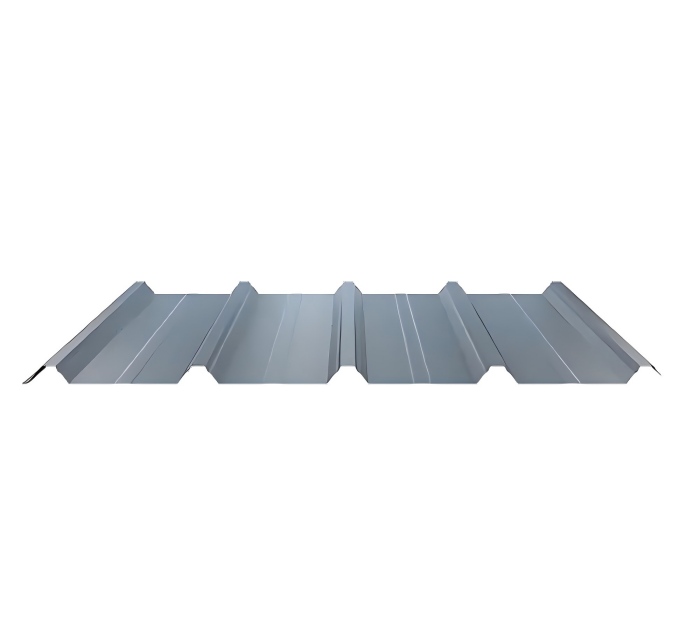
Profile depth is only part of the geometry.
The distance between ribs, the width of the crowns and valleys, and the presence of smaller intermediate stiffeners can all affect how the sheet behaves under load. These details determine how efficiently the formed section uses the available steel.
A narrow, frequently repeated corrugation will not behave in exactly the same way as a wide trapezoidal profile. Even if both products use the same nominal base-metal thickness, they distribute stress differently.
This becomes important when comparing profiled roof sheets from different manufacturers. Similar product descriptions do not necessarily mean similar structural capacity.
The profile drawing and span data are usually more useful than the thickness figure alone.
| Design Variable | Effect on Installed Performance |
|---|---|
| Profile depth | Changes bending stiffness |
| Rib spacing | Influences load distribution |
| Intermediate stiffeners | Helps control local deformation |
| Steel grade | Affects yield strength |
| Purlin spacing | Determines bending demand |
| Fastener layout | Influences uplift resistance |
| Side-lap geometry | Affects fit and weather sealing |
Nominal thickness does not describe the mechanical properties of the steel.
Two coils can have the same thickness while differing in yield strength, elongation, and forming behavior. Those differences become visible during roll forming and later when the roofing is subjected to wind, maintenance traffic, or repeated thermal movement.
A higher-strength steel can resist greater stress before permanent deformation begins, but it may also behave differently during profiling. Springback can increase, and forming settings may need adjustment to maintain accurate rib geometry.
This is why a roofing specification that states only “0.5 mm galvanized sheet” leaves out an important part of the material definition.
For repeat production, consistent mechanical properties are especially valuable. A roll-forming line performs more predictably when each incoming coil responds in roughly the same way.
Some roof sheet problems begin on the production line but only become obvious during installation.
If the profile dimensions vary slightly along the sheet length, the difference may seem insignificant when one sheet is inspected individually. Once dozens of sheets are installed side by side, however, those small deviations can accumulate.
The same applies to coil camber and flatness.
If the incoming steel sheet coil does not track consistently through the forming line, the finished sheets may be harder to align. Side laps can require more force to close, and installers may begin adjusting sheet positions to compensate.
At that point, what appears to be a site workmanship problem may actually have started with raw-material or roll-forming consistency.
For large factory and warehouse roofs, where sheets may run for considerable lengths, dimensional repeatability becomes particularly important.
Corrugated roofing is sometimes selected visually, but the wave geometry has a real structural function.
The repeated formed shape increases stiffness compared with flat steel and helps the sheet span between supports. However, the amount of improvement depends on the actual corrugation dimensions.
This is why corrugated steel sheets with different wave heights or pitches should not be assumed to perform identically.
A higher or more pronounced corrugation can provide greater stiffness, but practical design still needs to account for span, load direction, steel strength, and fastening method.
The profile should therefore be considered part of the roof structure rather than simply an architectural finish.
The same roofing sheet can feel very rigid on one building and noticeably more flexible on another.
Purlin spacing is often the reason.
When supports are closer together, each section of roof sheet spans a shorter distance and experiences lower bending demand. Increase that spacing and both stress and deflection increase.
This means a sheet that works well on one warehouse cannot automatically be transferred to another project without checking the structural arrangement.
The same principle applies when comparing supplier quotations. One manufacturer may recommend a profile based on shorter support spacing, while another may provide data for a deeper section capable of spanning farther.
Without checking those assumptions, price comparisons can become misleading.
Roofing sheets do not only carry downward loads.
Under wind suction, the sheet is pulled away from the supporting structure. In this condition, fasteners and the local steel around the fixing points become critical.
A relatively stiff profile may still perform poorly if the fixing pattern is inadequate. Local deformation can develop around screws, particularly when thin steel is over-tightened or when fasteners are positioned incorrectly relative to the profile.
Roof corners and perimeter zones can be more demanding because wind pressures are often higher there than in the central roof area.
For this reason, the fixing schedule should be treated as part of the roof design rather than as a standard installation detail copied from another project.
The side lap is usually discussed as a water-control detail, but it also influences installation accuracy and sheet interaction.
When profile geometry is consistent, adjacent sheets should fit together without excessive force. If the dimensions vary, installers may need to pull one sheet toward the next, which can distort the profile or change fastener positions.
These problems become more noticeable over long roof widths because small errors repeat across every sheet.
A well-controlled profile therefore improves both weathering performance and installation efficiency.
This is one reason manufacturing tolerance should be considered during supplier evaluation, particularly for large-volume industrial projects.
When two suppliers offer sheets of the same thickness, the next step should not be to compare price per square meter immediately.
First compare the actual profile.
Check rib depth, effective cover width, steel grade, base-metal thickness definition, recommended support spacing, and fixing guidance. If structural load tables are available, compare them against the real purlin arrangement and wind conditions of the building.
The goal is not to collect as many technical parameters as possible. It is to understand whether both suppliers are actually offering products capable of doing the same job.
A slightly more expensive sheet may be the more economical option if its profile allows appropriate spans, installs more consistently, and reduces adjustment on site.
Thickness remains an important specification, but it should never be used as the sole indicator of roof-sheet quality or strength.
Profile geometry determines much of the section stiffness. Steel properties influence how that profile forms and deforms. Support spacing establishes the load demand, while fasteners and laps determine how effectively those loads are transferred into the building.
These factors explain why two visually similar roof sheets can perform differently even when both are sold under the same nominal thickness.
For factories, warehouses, workshops, and other industrial buildings, selecting the profile around the actual structure is more reliable than choosing the material first and trying to make the building fit it later.
Yes. Different rib depths, profile shapes, steel grades, and support conditions can produce significantly different structural behavior even when the nominal steel thickness is identical.
A deeper profile generally increases bending stiffness, but the final capacity still depends on the complete section geometry, steel strength, span, and fixing arrangement.
The most useful checks are the actual profile geometry, steel grade, allowable span, and recommended fixing arrangement. These factors provide a much better indication of how the sheet will behave on the building.
Two profiled roof sheets with the same thickness are not automatically equivalent.
What matters is what happens to that thickness after the steel is formed and installed. A well-designed profile uses the material more efficiently, while consistent steel properties and accurate roll forming help preserve that performance from one sheet to the next.
For project procurement, the better comparison is therefore not simply “0.5 mm versus 0.5 mm.” It is whether each complete roofing profile is suitable for the actual span, load, fastening arrangement, and building conditions it will face.