English
  Español
  العربية
  русский
  ไทย
ไทย 
×
A rock wool panel is often chosen because a project has stricter fire-safety requirements, but the words “rock wool core” alone do not tell an engineer how the finished wall or roof will perform. In practice, fire behavior depends on how the core is arranged inside the panel, how consistently it is bonded to the metal facings, how the edges are formed, and how the panels are finally joined and fixed to the building.
This is where specifications sometimes become too simple. A procurement document may define core density and panel thickness, yet leave out the details that determine whether the finished assembly performs as expected under heat, pressure, and structural movement.
Rock wool itself is non-combustible and remains stable at temperatures far above those encountered in normal building operation. That makes it a strong core material for factories, warehouses, workshops, logistics facilities, and other buildings where fire performance is important.
But a finished rock wool sandwich panel should not be judged by the core alone.
A fire-rated wall or roof is tested as an assembly. The metal facings, adhesive, panel joint, fixing method, span, support structure, and installation direction can all influence the result. If one of those details changes significantly from the tested construction, the actual building may no longer behave in the same way.
This distinction is especially important when a project specifies a defined fire-resistance period. A non-combustible insulation core is valuable, but it is not the same thing as a verified fire-resistant wall system.
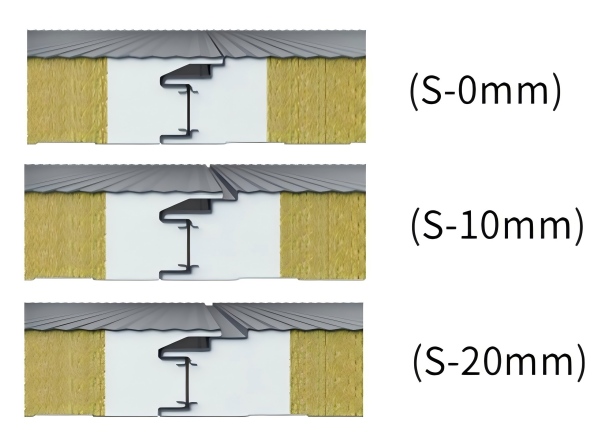
Rock wool is made from fibers, which means its internal structure is not identical to that of a rigid foam core.
In many sandwich-panel designs, the material is cut into lamellas and arranged so the fibers help transfer loads between the two steel facings. This improves the way the panel works as a composite element rather than as two thin sheets separated by insulation.
That arrangement matters well before a fire occurs.
If the lamellas are unevenly cut, poorly aligned, or leave small voids between adjacent pieces, the panel may have local areas with different stiffness or weaker bonding. These defects are not always visible from the finished surface. They often become more noticeable after transportation, installation, thermal cycling, or long-term loading.
This is why selecting a sandwich panel core material should involve more than comparing thermal conductivity and density. The way the material is processed inside the panel can be just as important as the material itself.
Not necessarily.
Density can affect mechanical strength, acoustic performance, and the behavior of the insulation under heat, but it should not be used as a shortcut for predicting the fire rating of the finished panel.
A denser core does not automatically compensate for a poorly designed joint or inadequate fixing arrangement. Likewise, a thicker panel does not guarantee a particular fire-resistance period unless that thickness has been evaluated as part of the complete construction.
For real projects, it is more useful to look at several connected factors:
| Panel Design Factor | Why It Matters in Practice |
|---|---|
| Core consistency | Reduces local weak areas inside the panel |
| Fiber orientation | Influences load transfer between the metal skins |
| Panel thickness | Affects heat transfer and structural behavior |
| Bonding quality | Keeps the core and facings acting together |
| Joint design | Maintains continuity between adjacent panels |
| Fixing arrangement | Helps the assembly remain stable during deformation |
| Openings and penetrations | Can interrupt the original fire-resistant construction |
The important point is not that one parameter matters more than everything else. It is that these parameters interact.
The adhesive layer is hidden once the panel leaves the production line, which makes it easy to underestimate.
During normal use, the bond between the insulation and steel facings allows the panel to behave as one structural element. When that bond is inconsistent, local separation can change how loads move through the panel.
Several production issues can cause this. The inner metal surface may not be sufficiently clean. Adhesive coverage may be uneven. The rock wool may not make consistent contact with the facing. Curing conditions may also vary.
A panel can still look acceptable after production even when one of these problems exists.
The consequences usually appear later. The facing may show local deformation, the panel may respond differently to repeated thermal movement, or weak areas may become more significant under high temperature.
For this reason, a reliable sandwich panel system depends heavily on process control that takes place before the finished panel can be visually inspected.
The center of a rock wool panel is relatively straightforward. The edges are more complicated.
At the panel edge, the continuous core is interrupted so that adjacent panels can connect. This is also where manufacturers need to manage weather sealing, air leakage, installation tolerance, and sometimes concealed fasteners.
Those requirements can compete with one another.
A joint that is easy to install is not automatically the best joint under fire exposure. Additional seals or accessories may perform differently from the rock wool itself. If heat reaches the connection quickly, the joint may become a more vulnerable area than the middle of the panel.
That is why project engineers should ask whether the fire classification applies to the actual joint configuration being supplied, not simply to a panel of the same nominal thickness.
There is no single correct thickness for every project.
A thicker rock wool panel generally slows heat transfer and can contribute to improved fire resistance, but the required thickness depends on the complete wall or roof design. Support spacing, panel orientation, joint construction, metal-facing thickness, and fixing arrangement can all affect the result.
The more reliable approach is to start with the required fire performance and then select the panel configuration that has been tested or engineered to meet it.
This also prevents unnecessary overspecification. Increasing thickness without understanding the assembly may add cost and weight without solving the actual weak point.
When an insulated building panel is being selected for a fire-sensitive project, thickness should therefore be treated as one design variable rather than the entire fire strategy.
A well-manufactured panel can still perform poorly if the site installation does not reproduce the intended construction.
This happens more often than many buyers expect.
If the supporting frame is misaligned, installers may struggle to close the joints correctly. If the fasteners are placed differently from the recommended pattern, load transfer changes. Openings made later for cable trays, ducts, pipes, or equipment can interrupt the insulation and create unprotected paths through the wall.
These details are especially important in production buildings where services are frequently added after the main envelope has been installed.
The safest approach is to coordinate penetrations and interfaces before installation begins, rather than leaving them to be solved on site.
Instead of asking only, “What is the density?” or “How thick is the panel?”, ask how the proposed configuration relates to the required building performance.
The supplier should be able to explain the core arrangement, the type of joint, the bonding process, the fixing method, and the fire documentation that applies to the complete system.
It is also worth checking whether the quoted panel matches the wall or roof orientation used in the relevant test or technical documentation. A configuration suitable for one application should not automatically be assumed to perform the same way in another.
For larger projects, this discussion should happen before the final panel schedule is confirmed. It is much easier to adjust a panel specification during design than to correct an unsuitable joint or fixing system after installation has started.
The biggest mistake in specifying rock wool panels is assuming that a good core material automatically produces a good fire-resistant building envelope.
Rock wool provides a strong foundation because of its non-combustible nature, but real performance comes from the complete panel construction. Core arrangement, bonding, edge design, joints, fasteners, supports, and installation quality all influence what happens when the assembly is exposed to fire.
For industrial buildings with defined fire-safety requirements, the panel should therefore be selected as a tested or engineered system rather than as a collection of individual material specifications.
When discussing a project with HEADSTREAM, providing the required fire classification, wall or roof drawings, panel spans, and key connection details makes it easier to select a configuration that fits the actual building rather than relying on core type alone.