English
  Español
  العربية
  русский
  ไทย
ไทย 
×
When a building envelope includes corners, curves, penetrations, or tight interface conditions, standard panels alone often can’t deliver the clean fit and reliable performance a project requires. That’s where sandwich panel fabrication becomes essential—transforming design intent into components that install efficiently, align accurately, and keep the enclosure system consistent.
This guide explains what fabrications mean in practice, which types are commonly used, and how to specify them for dependable results. For an overview of available options, visit Headstream’s Fabrications page.
In sandwich panel projects, “fabrications” are made-to-order elements that solve non-standard geometry and critical junctions. Instead of relying on field cutting and ad-hoc modifications, sandwich panel fabrication delivers pre-formed parts designed to match approved drawings and system requirements.
These fabricated pieces are typically used where the envelope must remain continuous—around corners, returns, openings, and transitions—so that thermal, air, and moisture-control layers stay coordinated. Done well, custom fabrications reduce jobsite variability and help keep the finished surface clean and consistent.
Factory-made custom fabrications help installation teams work faster because complex shapes and interfaces are resolved before delivery. With clear shop drawings and coordinated panel schedules, crews can follow a repeatable sequence rather than “making it work” at every transition.
They also support precision fabrication for folds, returns, edges, and cutouts—improving joint consistency and alignment across long elevations. Fewer uncontrolled site cuts typically means fewer finishing compromises and a lower risk of performance issues developing at weak points.
In many projects, tailor-made panels aren’t just about aesthetics; they’re a practical method to protect enclosure continuity while keeping the façade’s geometry accurate.
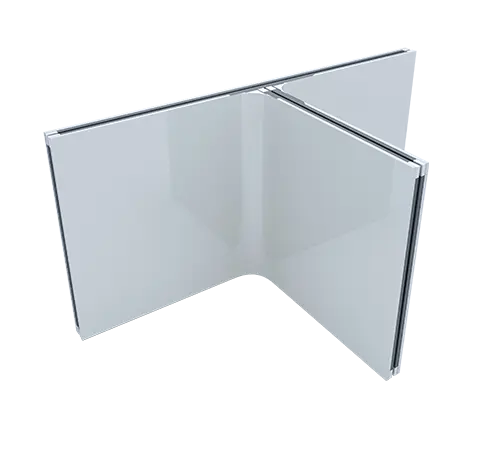
Most fabrication needs fall into a few categories that cover the majority of complex conditions. Choosing the right category early helps you standardize details and reduce exceptions during construction.
Common examples include corner panel components for inside/outside corners and returns, curved panels for radius elevations and feature zones, and special-shaped panel solutions for offsets, irregular geometry, or tight interface constraints. These are typically coordinated with the overall panel grid so transitions look intentional rather than patched.
To see how these options are grouped and supplied as a set, reference Fabrications for a practical overview.
Corners are both highly visible and technically demanding. A strong corner solution must maintain alignment, manage tolerances, and preserve enclosure performance while delivering clean lines.
A dedicated corner panel helps reduce on-site cutting and creates a repeatable geometry that installers can align quickly. For projects that require a more integrated approach, a corner sandwich panel can support continuity through the corner—helping keep the system build-up consistent where two planes meet.
To avoid common corner issues, coordinate the corner type (inside vs. outside), joint strategy, and how the corner interfaces with trims, openings, and adjacent materials. Getting these decisions locked early typically improves both buildability and final appearance.
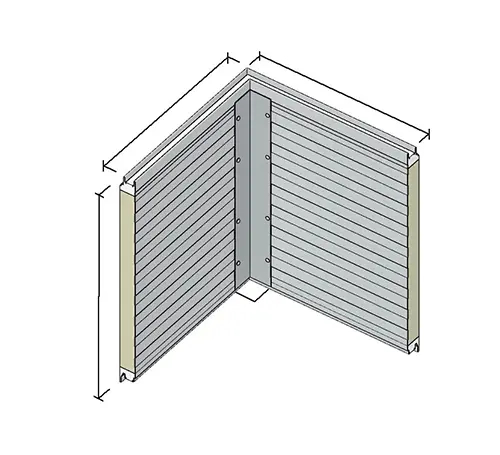
To ensure fabricated components install smoothly, define expectations clearly before production. A good sandwich panel fabrication specification usually addresses the following:
1. Panel module and allowable tolerances (including how tolerances are absorbed at joints)
2. Forming requirements (returns, fold lines, edge conditions)
3. Surface finish and coating consistency, especially at formed edges
4. Cutouts and reinforcements for penetrations, doors, windows, and accessories
5. Installation sequencing so fabricated parts arrive ready for the planned workflow
Where geometry is complex, a customized shaped panel approach can help maintain clean transitions and reduce field improvisation—especially around offsets or unusual junctions.
Successful envelope projects often depend on how well “non-standard” conditions are handled—corners, curves, transitions, and penetrations. With well-planned sandwich panel fabrication, teams can reduce jobsite cutting, maintain consistent alignment, and protect long-term enclosure performance. Selecting the right set of custom fabrications—from a corner sandwich panel to curved and special-shaped solutions—also makes installation more predictable and repeatable across the entire elevation.
When you’re ready to evaluate fabrication options, it’s worth partnering with an experienced manufacturer that can support both engineering coordination and stable production. As a producer of sandwich panels and cladding systems, HEADSTREAM provides fabrication solutions designed to integrate smoothly into real-world builds—see the range on Fabrications.