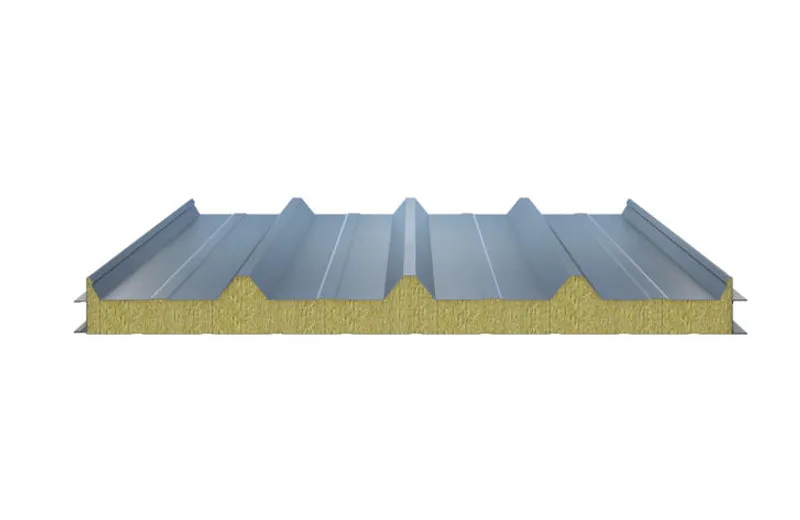
Water leakage is one of the most common concerns in sandwich panel roof systems, especially around panel joints, end laps, fasteners and roof penetrations. A good roof sandwich panel is only part of the solution—the joint design and installation quality are equally important.
Design the Joint for Water Drainage
Roof panels should be installed according to the designed roof slope and panel direction. Water should naturally flow toward the drainage system instead of accumulating around the joints.
For long-span roofs, designers should pay particular attention to transverse joints and end laps. EN 14509 testing for water permeability considers the complete panel assembly, including joints, fixings, seals and flashings.
Use the Correct Sealing System
A reliable roof sandwich panel joint normally combines the panel's interlocking profile with suitable sealing materials.
Depending on the system, this may include:
· Factory-applied joint seals
· Butyl tape or sealing strips
· Compatible weather-resistant sealant
· Properly designed flashings
· Correctly installed fasteners
Installation guidance for insulated sandwich panels also recommends sealing panel joints and flashing interfaces progressively during installation rather than leaving them exposed.
Control Fastener Installation
Over-tightened screws can deform the metal skin and damage the sealing washer, while under-tightened screws may leave gaps around the fixing point.
For this reason, fastener spacing, screw type, washer quality and installation torque should follow the panel manufacturer's technical specifications.
Pay Special Attention to End Laps
End laps are particularly sensitive because two panels meet in the direction of water flow.
A published investigation of a composite panel roof in Scotland recorded more than 500 active leak positions; over 95% were located directly below panel end laps. The roof used 40 mm polyisocyanurate panels with 150 mm end laps.
This illustrates why end-lap design should be considered during the design stage—not treated as a finishing detail.
Choose the Right Roof Sandwich Panel
A roof system must balance thermal insulation, structural requirements and weather resistance.
For example, PIR/PUR sandwich panels can provide low thermal conductivity. Published panel data shows PUR/PIR values around 0.022 W/(m·K) for some products, while 50 mm panels can achieve U-values around 0.44 W/m²K depending on the complete system.
Conclusion
Preventing leakage is not simply a matter of applying more sealant. The key is to coordinate roof sandwich panel design, panel orientation, joint geometry, end laps, fasteners, sealing and flashing details as one system.
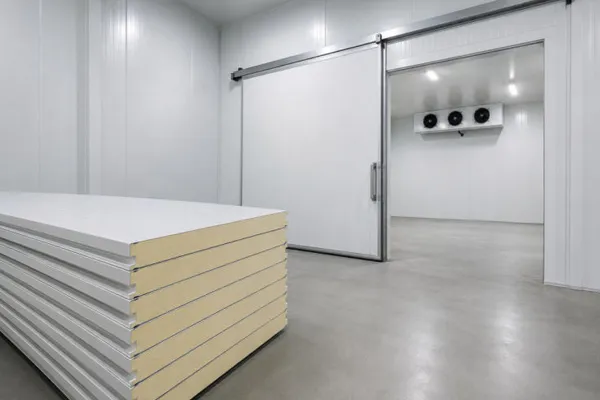
For industrial buildings, warehouses, cold storage facilities and other large-span structures, choosing the correct PIR sandwich panel, PU sandwich panel or rock wool sandwich panel at the design stage can reduce installation and maintenance risks.
 English
 Español
 العربية
 русский
 ไทย